
The Marketing Metrics Battle for Long-Term Growth
In the world of digital marketing, metrics are more than numbers—they’re the compass that guides every decision you make. Among the many acronyms floating around in strategy meetings, two stand out: ROAS (Return on Ad Spend) and LTV (Customer Lifetime Value).
Both are vital, but they tell very different stories. ROAS focuses on immediate returns, while LTV looks far into the future. The big question is: which one should you prioritize if you want your business to thrive for years to come?
Understanding ROAS: Your Short-Term Profitability Gauge
ROAS is a straightforward metric. It measures how much revenue you earn for every dollar you spend on advertising. If you invest $1,000 in ads and bring in $4,000 in sales, your ROAS is 4:1—or 400%. Simple, clear, and incredibly useful.
That’s why marketers love ROAS—it gives you instant feedback on whether a campaign is pulling its weight. According to Shopify’s ROAS Guide, a standard benchmark for e-commerce businesses is between 3:1 and 4:1, though this varies by industry.
However, ROAS has one major limitation: it’s blind to the future. If a customer buys from you once today and then spends hundreds more over the next year, ROAS doesn’t see that value.
How to Calculate ROAS
The formula for ROAS is simple:
ROAS = Revenue from Ads ÷ Advertising Spend
Example:
- Revenue from a campaign: $6,000
- Ad spend: $2,000
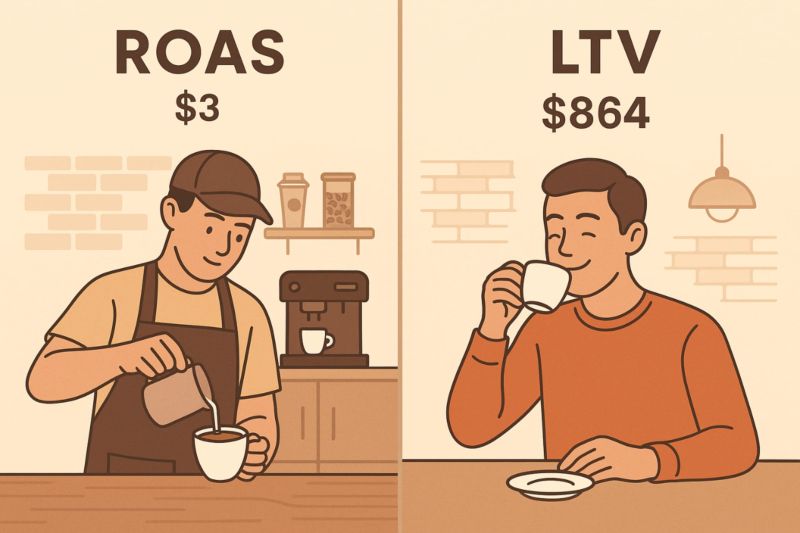
ROAS = $6,000 ÷ $2,000 = 3 This means you earned $3 for every $1 spent on ads (or 300% ROAS).
Understanding LTV: The Long Game
Customer Lifetime Value, or LTV, takes a different approach. Instead of looking at what a customer spends today, it estimates how much revenue that customer will generate over the entire relationship with your brand.
Imagine a coffee subscription service. A new subscriber might pay $20 for the first month. That’s it—so far, not impressive. But if they stay subscribed for two years, they’ll spend $480. That’s the power of LTV—it helps you see the true worth of a customer.
As explained in HubSpot’s Customer Lifetime Value Guide, understanding LTV allows businesses to justify higher acquisition costs, knowing the long-term return will be substantial.
LTV is essential for businesses with repeat customers, subscription models, or strong brand loyalty. It encourages you to invest in customer experience, retention, and relationship-building. But there’s a catch: it requires solid data and sometimes patience to calculate accurately.
How to Calculate LTV
A basic formula for LTV is:
LTV = Average Purchase Value × Purchase Frequency × Customer Lifespan
Example:
- Average purchase value: $30
- Purchases per year: 12
- Average customer lifespan: 2.4 years
LTV = $30 × 12 × 2.4 = $864 This means the customer is worth $864 over their lifetime.
The ROAS vs. LTV Showdown
One of the most significant difference between ROAS and LTV comes down to timeframe. ROAS is like checking your speedometer—you know exactly how fast you’re going right now. LTV is more like your GPS—it’s planning the entire journey.
This is where many businesses get tripped up. They cut campaigns with low ROAS without realizing that those campaigns are bringing in high-LTV customers. Imagine spending $50 to acquire a customer who initially spends only $60. Not great, right? But what if that same customer ends up spending $360 over the year? Suddenly, that “bad” campaign looks like a goldmine.
Which Metric Matters More for Long-Term Growth?
If your goal is to build a brand that lasts, LTV takes the crown. It shifts your mindset from short-term wins to sustainable growth. It allows you to spend more to acquire high-quality customers because you know they’ll keep coming back.
That said, you can’t ignore ROAS completely. As Neil Patel points out, ROAS is your early warning system—if it’s consistently poor, you may be overspending before you ever see a return.
The most successful marketers use both. ROAS ensures you’re staying profitable in the moment, while LTV tells you whether you’re building a business that will still be strong years from now.
Making Them Work Together
The magic happens when ROAS and LTV are used in harmony. Start by identifying the customer segments with the highest lifetime value.
Design campaigns that attract more of those customers—even if the initial ROAS isn’t sky-high. Use retention strategies like personalized drop email/sms campaigns, loyalty programs, and exceptional post-purchase experiences to keep those customers engaged and spending.
Final Takeaway
Think of ROAS as the oxygen keeping your business alive day-to-day, and LTV as the food that helps it grow stronger over time. You can’t ignore either one. Use them together, and you’ll have a marketing strategy that delivers not just quick wins, but sustainable, scalable success.
Discover more from Guillermo Wolf
Subscribe to get the latest posts sent to your email.
